From concept development to final asset production, PixAI helps anime creators complete multiple stages of a project within one connected platform.
NEW YORK CITY, NY, UNITED STATES, July 30, 2026 /EINPresswire.com/ — PixAI, an anime-style AI art platform and creator community, supports an end-to-end creative workflow that helps users turn early ideas into finished illustrations, character assets, promotional visuals, and other anime-style content.
Creating a polished visual often involves more than entering a single prompt. Creators typically move through several interconnected stages, including concept development, visual exploration, image generation, refinement, consistency management, and final asset preparation. By bringing these steps into the same creative environment, PixAI allows users to develop a project continuously instead of moving between separate tools at each stage.
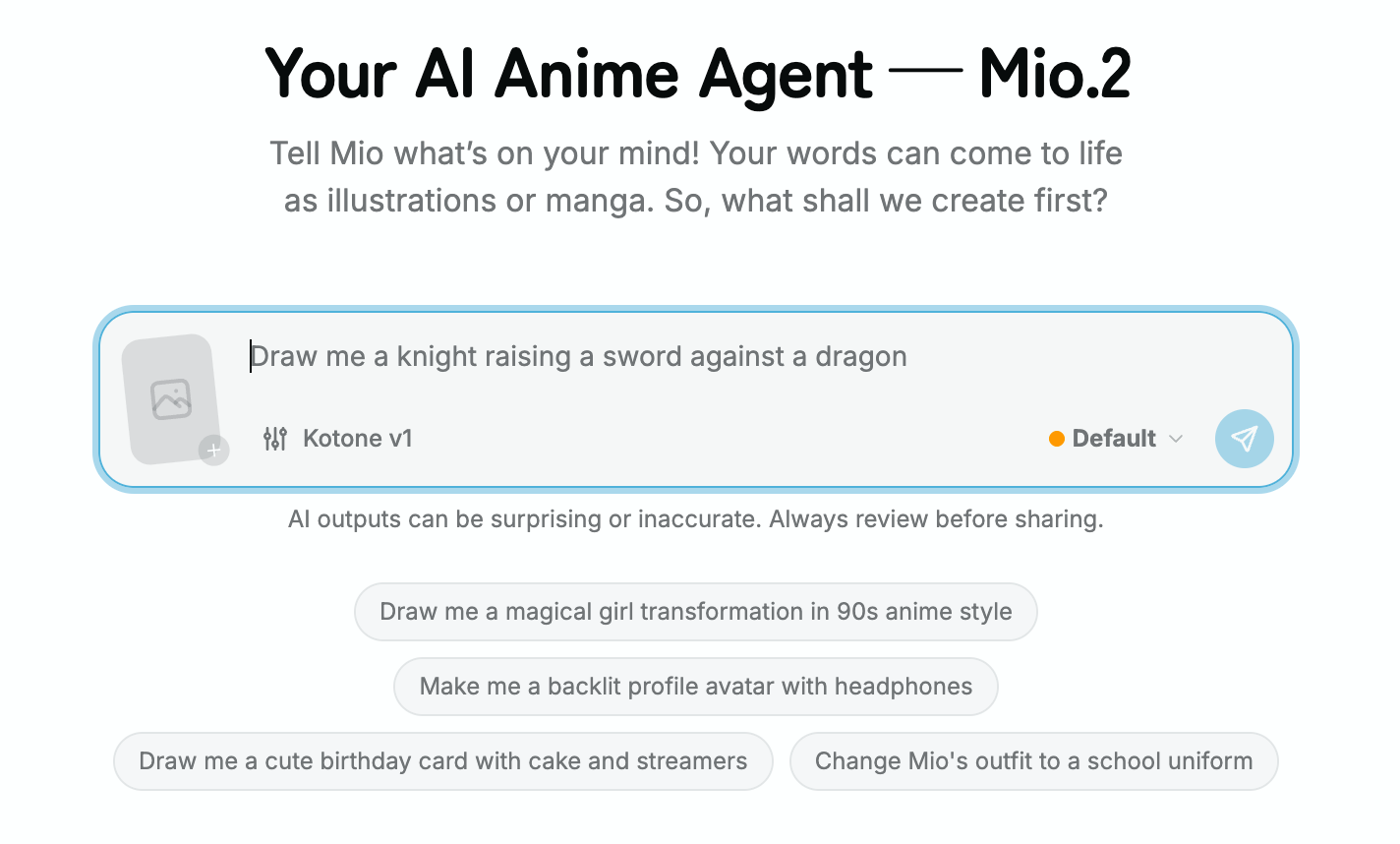
A project may begin with a rough character idea, story scenario, visual mood, or reference image. Mio.2, PixAI’s conversational creation assistant, works within the image-generation process to help users explore different concepts, visual directions, and ways of prompting. Through natural-language interaction, users can adjust character personalities, settings, outfits, expressions, compositions, and narrative situations until they arrive at a prompt, visual direction, or image reference they want to develop further.
During the same exploration process, creators can draw inspiration from PixAI’s community gallery and discover reusable resources through the Model Market. The gallery includes anime-style works across original characters, fan art, fantasy settings, seasonal illustrations, and visual storytelling projects, helping users examine different approaches to composition, color, lighting, and character presentation. The Model Market provides community-created models and LoRAs with sample images, compatibility information, trigger words, and recommended settings, so users can move directly from discovering a visual direction to testing it in their own generations without leaving the platform.
Creators can then generate and compare multiple versions of a character or scene, testing different hairstyles, outfits, poses, expressions, camera angles, lighting conditions, and backgrounds. PixAI’s proprietary anime-focused models, including Tsubaki.2 and Haruka v2, support different illustration styles and creative goals, while Mio.2 can continue assisting users as they refine their prompts and explore alternative concepts during generation. This keeps ideation and image creation connected rather than treating them as separate steps.
After the first image is generated, the workflow moves into iterative refinement. Creative practices shared by the PixAI community suggest that stronger results often come from gradual adjustment rather than attempting to solve every visual element at once. Creators may first confirm the main composition and character design, then refine lighting, pose, background, text, or smaller details one step at a time. Because these adjustments can be carried out within the same workflow, creators can preserve the project’s established direction while progressively improving the image.
For projects that require long-term character consistency or a unified visual style, creators can incorporate LoRAs and other reusable visual resources. Character LoRAs can help preserve recognizable traits across multiple images, while style, pose, outfit, and detail LoRAs can introduce more specialized visual elements. Multiple compatible LoRAs can also be combined within one generation, allowing creators to retain a character’s identity while changing the outfit, pose, atmosphere, or overall style.
PixAI also allows users to train custom LoRAs for original characters, styles, outfits, poses, and other visual concepts. Once created, these resources remain available for reuse across later generations and projects, reducing the need to rebuild the same character or visual direction from the beginning. This can support more consistent production across character sheets, visual novels, promotional content, social media projects, and longer-form visual storytelling.
After selecting a promising image, creators can move into more detailed editing without restarting the entire process. PixAI Flow Edit serves as the continuous editing workspace, allowing users to refine an existing image through natural-language instructions and choose between two editing models according to the needs of the project. PixAI Edit Pro focuses on advanced instruction following, multi-image understanding, and precise control, while PixAI Reference Pro allows users to guide edits with up to 10 reference images to preserve characters, outfits, styles, and other visual details. Additional tools support inpainting, outpainting, image variations, enhancement, and canvas extension.
This connected process allows users to move back and forth between generation, reference-based guidance, LoRA-supported consistency, and detailed editing as a project develops. Instead of requiring a rigid sequence, PixAI keeps the main creative resources accessible within one platform, making it easier to revisit earlier decisions and continue refining an established visual direction.
Once refined, finished images can be adapted for a variety of creative uses, including character portraits, reference sheets, fan art, original character illustrations, manga concepts, cover art, social media visuals, thumbnails, promotional materials, and merchandise mockups. The same character, LoRA, prompt direction, or reference material can then be reused across new scenes and formats, supporting broader projects such as visual storytelling, campaign development, world-building, and branding without rebuilding every asset from the beginning.
By connecting concept exploration, inspiration discovery, image generation, iterative refinement, consistency management, and detailed editing, PixAI provides a unified anime creation environment for users at different levels of experience. Rather than functioning only as a one-time image generator, the platform supports the continued development of an idea from its earliest direction to reusable, finished visual assets.
“Our goal is to help creators develop an idea across multiple stages, rather than stopping after a single generation,” said a Mewtant spokesperson. “By keeping ideation, generation, reusable creative resources, and editing within one connected environment, PixAI helps users maintain continuity as their projects become more detailed and complex.” Guided by the slogan “Imagination, made real,” PixAI continues to develop anime-focused models and creative tools that make digital content creation more flexible and approachable.
About PixAI
PixAI is an anime-style AI art platform. Powered by its proprietary image foundation model, PixAI has been trusted by 15 million+ registered users across the US, Korea, and Japan since 2022. The platform offers a full creative toolkit—from anime-style illustration and image generation to image-to-video—alongside a social gallery where creators generate over 200 million artworks every month. Its conversational assistant, Mio.2, lets anyone turn a plain description into finished anime art, no prompts required.
Media Contact
cooperation@withpixai.art
Mewtant Inc.
https://go.pix.ai/ein
Shanshan Long
Mewtant inc.
+1 929-541-9770
email us here
Legal Disclaimer:
EIN Presswire provides this news content “as is” without warranty of any kind. We do not accept any responsibility or liability
for the accuracy, content, images, videos, licenses, completeness, legality, or reliability of the information contained in this
article. If you have any complaints or copyright issues related to this article, kindly contact the author above.

Media gallery