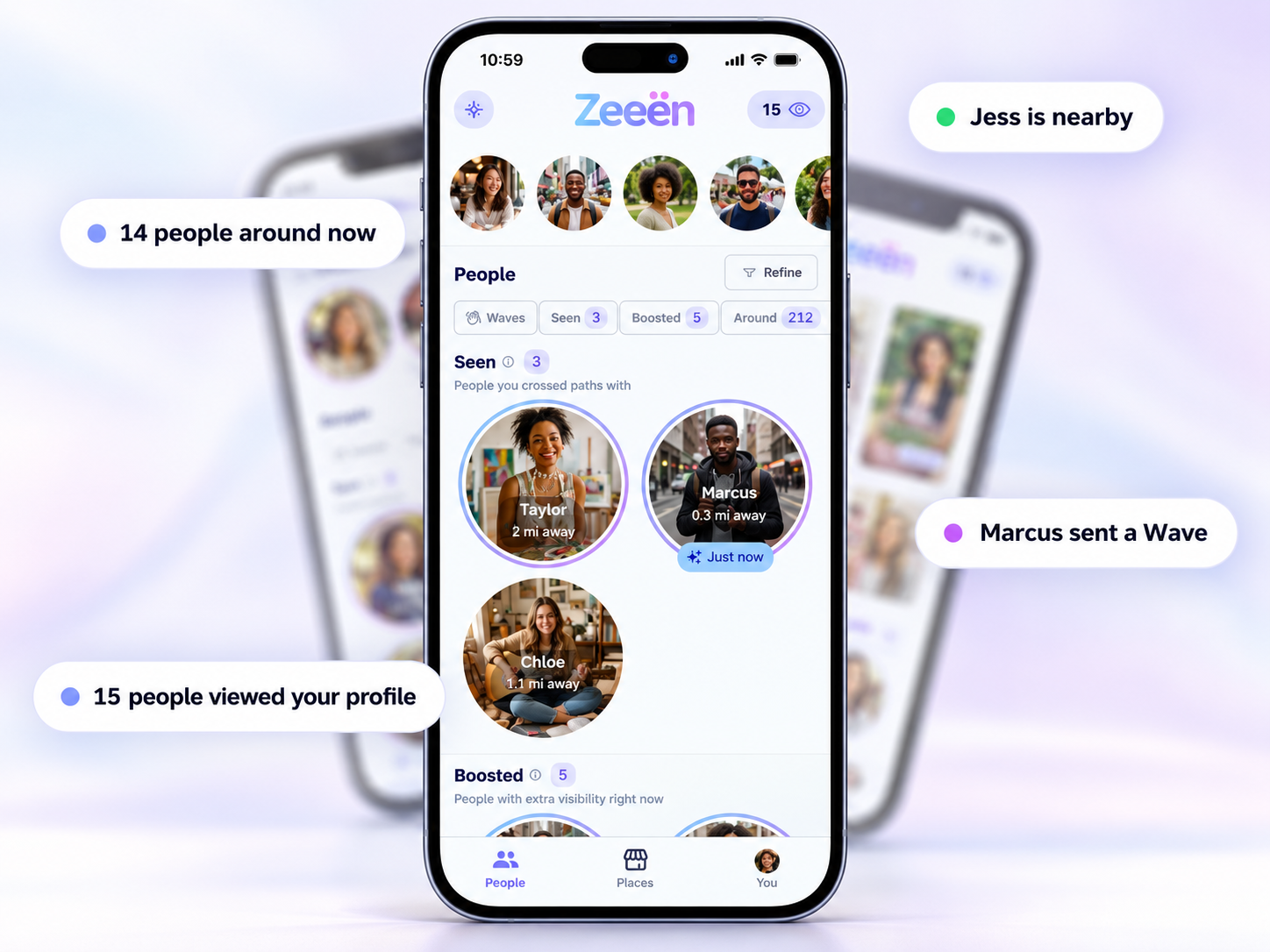
Zeeën launches in the US, helping people discover shared interests with strangers they cross paths with and connect without swiping or awkward introductions.
LOS ANGELES, CA, UNITED STATES, October 13, 2026 /EINPresswire.com/ — Striking up a conversation with a stranger can be awkward, especially when you have no idea whether you have anything in common. A new social discovery app launching in the United States aims to change that by helping people find common ground with others they already cross paths with, without requiring swiping, matchmaking or awkward introductions.
Called Zeeën, the platform helps users discover potential friends and contacts in their wider area, whether at a café, gym, university campus or workplace, and learn about their shared interests before deciding whether to connect.
Unlike conventional social media and dating platforms, Zeeën is designed around spontaneous, real-world social discovery rather than follower networks, content feeds or romantic matching.
The launch comes as a national survey found 54% of US adults experienced feelings of isolation at least some of the time, with half also reporting feeling left out or lacking companionship.¹
The platform displays profiles of other users in the surrounding area, ordered from closest to furthest away, including their interests and links to social media accounts they have chosen to make available.
Users can send a low-pressure digital greeting called a Wave, which recipients can choose to return. When two users Wave at each other, they can start a private conversation through Zeeën’s in-app chat.
They can also choose to share links to existing social platforms such as Instagram, TikTok and LinkedIn, giving them control over how they want to connect.
Zeeën.io co-founder Justin Mackay says the idea emerged from a contradiction in how modern social technology operates.
“Social media makes it incredibly easy to connect with someone on the other side of the world, yet we can know almost nothing about the interesting people in our own communities who might share our interests.
“The idea was to give people some context before that first interaction. If you can see that somebody nearby also runs, has a dog, follows the same sport or shares another interest, they no longer feel like a complete stranger but someone who is genuinely like-minded.
“Most social platforms are built around people we already know, people we follow or content we’re shown. We think there’s an opportunity for the next evolution of social media to help people discover new connections too.
“The app provides the accessibility and familiarity of digital technology, but the objective is still human connection in the real world,” says Mackay.
Early data from the platform suggests opportunities for new connections may be more common than people realize.
The company says around one in three active users have crossed paths with another active user, while profiles viewed by users shared an average of 59% of interests, compared with 35% expected by chance.
Registered psychologist Sara Chatwin says people can be surrounded by others every day and still experience loneliness because they lack meaningful social connections.
“For many adults, making new friends can be surprisingly difficult. Once we leave school or university, some of the environments where relationships traditionally formed naturally disappear and approaching a complete stranger can feel uncomfortable or socially risky,” she says.
Chatwin says the uncertainty surrounding an initial conversation can discourage people from approaching someone new.
“One of the hardest parts of meeting someone new is getting through that ‘tell me about yourself’ stage, which a lot of people dread. If you already know you have something in common, some of that awkwardness is removed and the interaction can start from a more comfortable place.
“Finding people with whom you share interests can create an immediate sense of inclusion and validation. That feeling of belonging can be particularly important for somebody who has moved to a new city or country and does not yet have an established social network,” she says.
The platform has also been designed to address privacy concerns associated with location-based social apps.
Rather than displaying people on a live map, it uses proximity-based discovery without revealing users’ exact locations to others. Individuals can control when they are visible, choose which social accounts to share, and block or report other users.
Mackay says the technology is intended to remove some of the pressure involved in meeting new people, without replacing face-to-face interaction.
“A lot of existing social platforms are built around people you already know, people you follow or content you consume.
“We see Zeeën as the next evolution of social media. We’re turning that idea outward, helping people discover new people in their wider community, find what they have in common and actually start a conversation.
“The aim is not to replace real-world interaction. It is to make that first step less random and potentially less awkward,” he says.
The US launch follows an Australian pilot that attracted thousands of registered users within weeks.
Zeeën is available to download free on the Apple App Store and Google Play, with optional paid features.
-ENDS-
About Zeeën:
Zeeën is designed to make real-world social discovery easier by helping users discover other Zeeën users in their wider area, identify shared interests and view only the social profiles they have chosen to make available.
Rather than approaching a complete stranger with no context, users can read a profile, see common interests and visit shared social accounts before deciding whether to connect.
Zeeën is designed around discovery rather than tracking. It does not show people on a live map, and users remain in control of their visibility and the information they share.
Zeeën Places and Events will extend this by helping users discover local businesses, venues, activities and events.
Mark Devlin
Impact PR
mark@impactpr.co.nz
Visit us on social media:
LinkedIn
Legal Disclaimer:
EIN Presswire provides this news content “as is” without warranty of any kind. We do not accept any responsibility or liability
for the accuracy, content, images, videos, licenses, completeness, legality, or reliability of the information contained in this
article. If you have any complaints or copyright issues related to this article, kindly contact the author above.

Media gallery